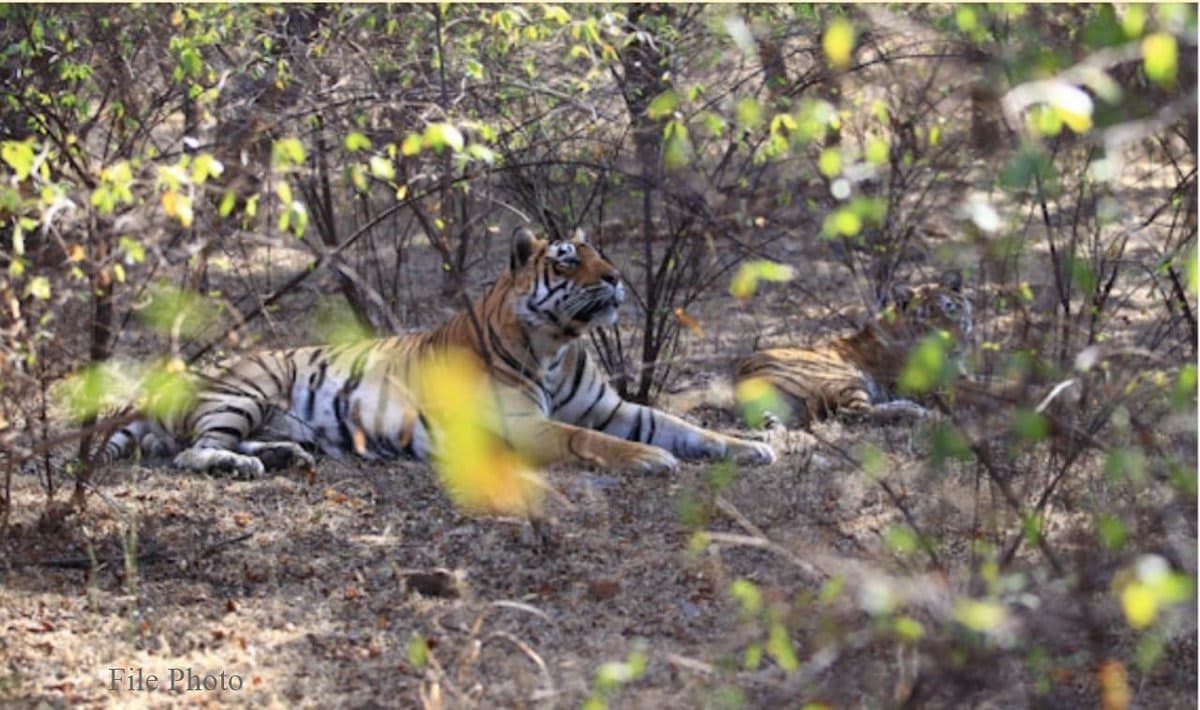
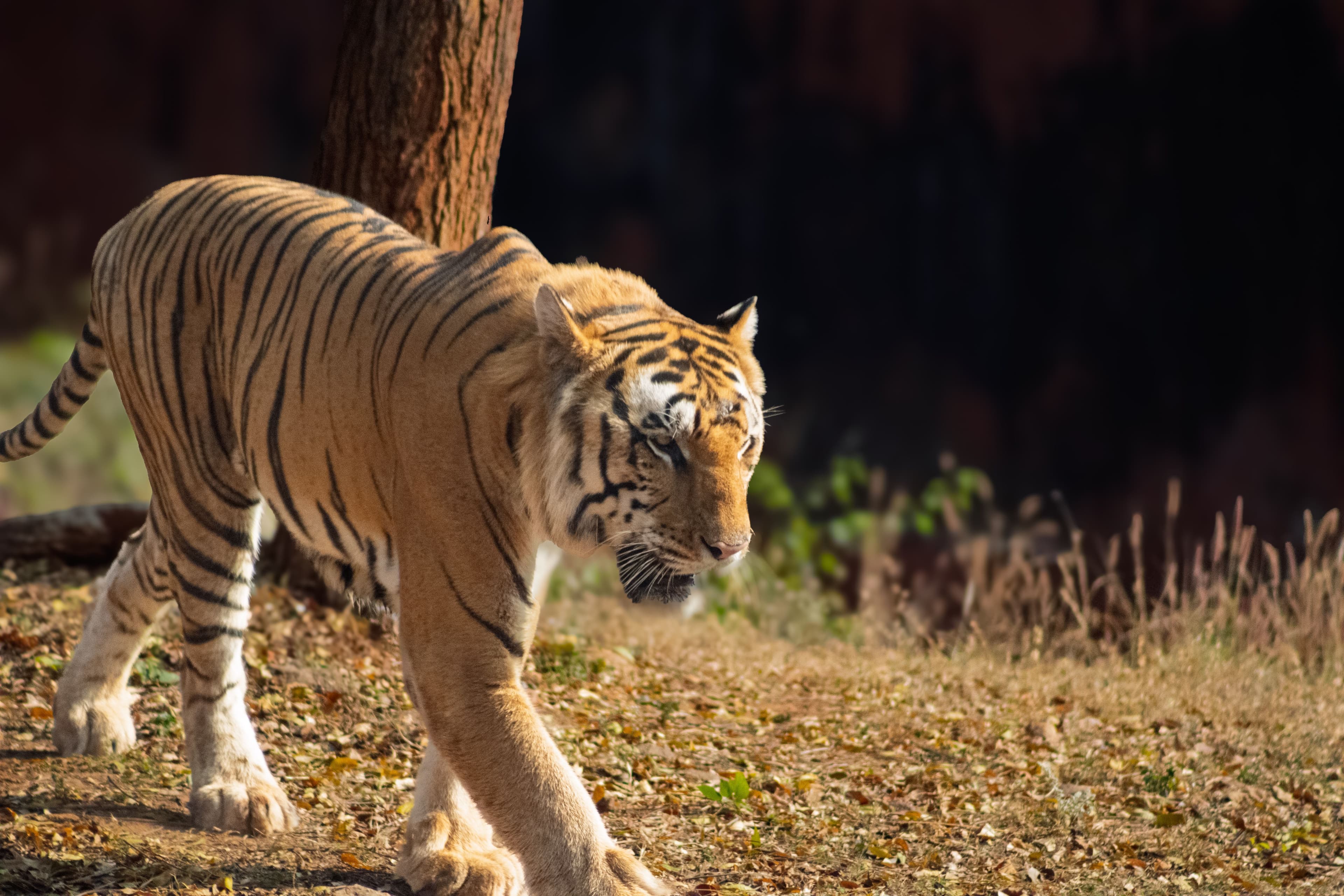
T-25, known throughout Ranthambore as Dollar, was one of the park's most distinctively marked and formidable males — a tiger as famous for his fearsome temperament as for the unusual act of tenderness that made national headlines. His popular name comes from a marking resembling the "$" dollar symbol on his flank, while a separate "AND"-like pattern between his eyes gave guides a second, unmistakable way to identify him. To regulars he was also known by a darker nickname: Zalim, "the cruel one."
Bloodline — Brother of a Legend
Dollar was one of three cubs born to the tigress Gayatri (T-22) and fathered by the male Jhumaru (T-20). His brothers were formidable in their own right: T-23, known as Bhola, became the resident male of the Guda and Lahpur area, while his other brother was none other than Ustad (T-24), the powerful and controversial tiger later relocated to Udaipur after being declared a man-eater. To share a litter with Ustad places Dollar at the centre of one of Ranthambore's most storied male lineages.
Territory in the Eastern Zones
Dollar established his territory in the rocky, undulating terrain of Zones 4 and 5 in the eastern sector of the core area, ranging across Singh Dwar, Gular Kui, Tamba Khan, Kachida, Dhakda and Bakola. This landscape of boulder-strewn ridgelines, open grassland valleys and seasonal waterholes gave him a very different habitat from the famous lakeside tigers of the western zones. He was known for using elevated rocky vantage points to survey his domain and monitor the movements of prey, and his corner of the park developed a reputation for a wilder, less "touristy" character than the busy lake zones.
The Fearsome 'Zalim'
Dollar earned his nickname honestly. He was an unusually aggressive tiger, both in the relentless way he expanded his territory and in his behaviour toward safari vehicles — he was known to growl and mock-charge, sending genuine shivers through visitors who encountered him at close range. This ferocity made him a dominant force in the eastern zones for years, holding and enlarging his range against a steady stream of rival males as Ranthambore's growing tiger population pushed young contenders into every corner of the reserve.
The Softer Side — A Male Tiger Who Raised Orphans
For all his fearsome reputation, Dollar is best remembered for something almost unheard of in the wild. In February 2011, the tigress T-5 died of an intestinal illness, leaving two young female cubs orphaned. Male tigers play no part in raising cubs and will sometimes even kill them — yet Dollar took the two orphans under his protection and reared them, a genuinely extraordinary act that was documented by the Forest Department and widely reported. It remains one of the most remarkable pieces of tiger behaviour ever recorded at Ranthambore, and it complicated the simple picture of Dollar as merely a brute. His own cubs, fathered with tigresses whose ranges overlapped his, added further branches to the park's expanding tiger family tree.
Death in Battle
Life as a dominant male in Ranthambore is rarely a peaceful one, and Dollar's tenure ended violently. He died in January 2020, believed to have been killed in a territorial fight with T-66, a younger male who ranged in the same area alongside the tigress T-54. The post-mortem told the brutal story plainly: the crushed bones of his skull and the puncture marks of canine teeth. It was a fittingly fierce end for a tiger who had spent his life fighting for and holding his ground.
Legacy
Dollar's story — part fearsome warrior, part unlikely foster father — captures the full complexity of a wild tiger's life in a way few individuals do. In a park that has produced so many legends, he stands out as a reminder that the wildlife of Ranthambore cannot be reduced to simple characters, and that the eastern zones he ruled hold stories every bit as compelling as those of the famous lakes.
Frequently Asked Questions
How did the tiger Dollar (T-25) get his name?
His name comes from a marking resembling the "$" dollar symbol on his flank. A separate "AND"-shaped pattern between his eyes gave guides a second reliable way to identify him. He was also nicknamed Zalim, meaning "the cruel one," for his aggressive nature.
Is Dollar the tiger still alive?
No. Dollar (T-25) died in January 2020, believed to have been killed in a territorial fight with a younger male, T-66. The post-mortem found a crushed skull and canine puncture wounds.
Is it true a male tiger raised orphaned cubs in Ranthambore?
Yes. In 2011, after the tigress T-5 died of illness, Dollar took in and reared her two orphaned female cubs — an extraordinary act, since male tigers normally play no role in raising young and can even kill cubs. It remains one of the most remarkable behaviours ever recorded in the park.
Similar Articles
Machli (T-16) — The Tiger Queen of Ranthambore
Discover the captivating story of Machhli (T-16), Ranthambore’s most famous tigress. Known as the "Crocodile Killer" and "Queen of the Jungle," her fierce spirit, legendary battles, and extraordinary legacy redefined the wilderness of India.
Is really Ustad (T-24) a Man-Eater?
Was Ustad (T-24) truly India's most feared man-eater, or was he a wild tiger caught in the growing conflict between greedy human and nature? Unearth the story behind one of Ranthambore's most controversial legends.
Aurangzeb (T-57) — The Male Behind Ranthambore's Zone 1 Cubs
Aurangzeb (T-57), also recorded as Singhasth, was a dominant Ranthambore male who fathered Noor's 2016 litter — including Sultana. He did not, despite the myth, father Riddhi and Siddhi.
Ganesh (T-120) 'Charger' — The King of Ranthambore's Lakes
Ganesh (T-120), the mock-charging male of Zones 3–4, is Riddhi's mate, father of Shubh and the 2026 cubs — and, through his mother Chanda, a great-great-grandson of Machhli himself.
Husn Ara (T-30) — Matriarch of the Gilai Sagar Line
Husn Ara (T-30), a prolific tigress of the Gilai Sagar dynasty, mothered a string of well-known Ranthambore tigers including Hamir (T-33), Fateh (T-42) and Surzan (T-43).