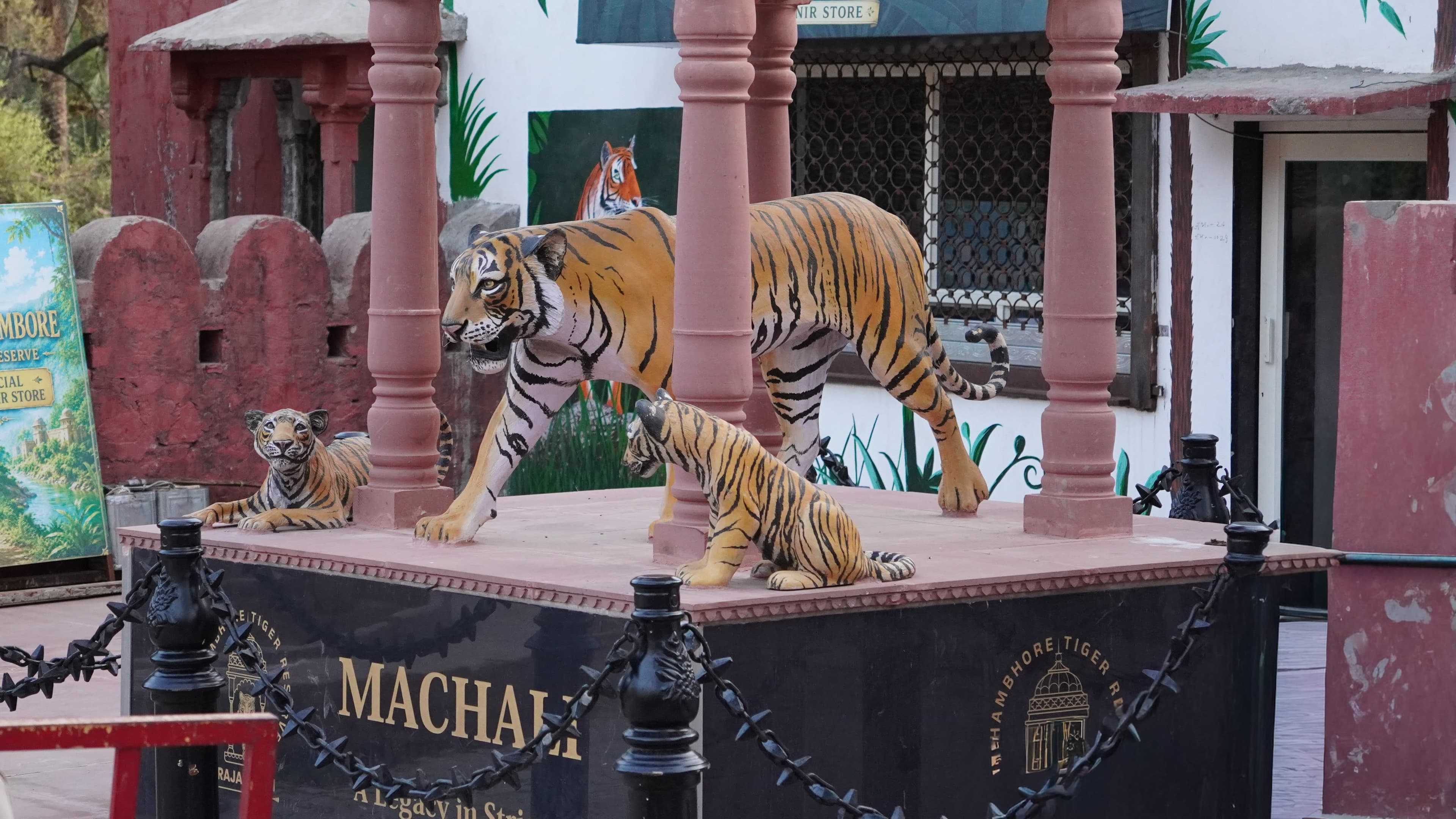
Machli — officially T-16, and spelled Machhli or Machali in different records — was the most celebrated wild tiger in the history of Ranthambore National Park, and by most measures the most famous wild tiger on Earth. To photographers she was the most photographed tigress ever documented. To conservationists she became the face of India's tiger revival. In Rajasthan she was simply royalty: the Queen of Ranthambore, the Lady of the Lakes, the Crocodile Killer. She ruled the lakeside heart of the park's Zones 1, 3 and 6 for more than a decade, killed a fourteen-foot crocodile in front of a line of camera lenses, raised eleven cubs, and left behind a bloodline that still rules the water she once owned.
The Birth of a Legend
Machli was born in the spring of 1997, one of three cubs of a dominant tigress the guides had already named Machli for the same fish-shaped mark on the left side of her face — machli means "fish" in Hindi, and it is why the daughter appears in older records as Machli II or "Machli Junior". She inherited more than the name. Even as a cub she was unusually confident: unbothered by vehicles, quick to learn from her mother, already stalking with the patience of an adult. That calm around people would later make her the most filmed tiger in the world. The ruins, lakes and dry ravines below Ranthambore Fort were her classroom, and she learned them completely.
The Rise of the Queen
Most young tigresses drift to the edges of their mother's range and settle for whatever is left. Machli took the centre. By around four years old she held the richest territory in the park — the shores of Padam Talao and Rajbagh Lake, thick with sambar, ringed by ruins, and never short of water — and she took it from her own mother. Holding it meant constant conflict: rival tigresses, wandering males, and fights that safari visitors watched from open jeeps. She combined patience with perfect timing, knowing when to fight and when a single unhurried walk down the shoreline was enough to settle the question. She held that range for more than ten years, and people flew across the world for one glimpse of her.
The Warrior Queen: The Crocodile Fight
In 2003, at the edge of the shrinking summer lakes, Machli fought and killed a mugger crocodile estimated at around fourteen feet — a kill almost never documented in wild tigers. The fight ran close to an hour in shallow water, photographers watching an animal built for crushing bone against one built for speed and precision. When it ended the crocodile was dead, and Machli had a new name: the Crocodile Killer.
The victory cost her two canine teeth. For the rest of her life she killed with raw jaw strength alone, unable to puncture prey the way an uninjured tiger does — and still she hunted successfully for another decade. Remarkably, the trait outlived her. Her granddaughter Arrowhead and great-granddaughter Riddhi have each been recorded killing crocodiles in the same lakes: three generations of one bloodline repeating the same impossible hunt.
Mother of a Dynasty
Had Machli only been a fighter she would still be remembered. Her greater achievement was lineage. Between 1999 and 2006 she raised five litters totalling eleven cubs — seven daughters and four sons — an extraordinary survival record for a wild tigress. Her offspring read like a roll call of Ranthambore history: Broken Tail, whose lone journey out of the park became the documentary Broken Tail: A Tiger's Last Journey; Slant Ear and Nick Ear; Jhumari and Jhumaroo; Bubbly (T-1) and Bunty (T-3); and the famous final litter of 2006 — Sundari (T-17), Baghani (T-18) and Krishna (T-19), the daughter who inherited the lakes and carried the dynasty forward.
Her line did not stop at the park boundary. In 2008 two tigresses of her blood were relocated to Sariska Tiger Reserve, which had lost every one of its tigers to poaching — making Machli the foundation of an entire recovered population. Through her son Jhumaroo, better known as T-20 Jhumroo, she was grandmother to Ustad (T-24), the park's most controversial male. Ranthambore's tiger count rose from roughly 15 in 2004 to more than 50 by 2014 as her descendants spread, and over half the tigers in the park today carry her genes. You can trace every branch of it on our verified tiger family tree.
The Tigress Who Saved a Park
Machli's influence reached far past the jungle. Because she was untroubled by vehicles, her life was documented in detail no wild tiger had received before: the BBC filmed her for the Natural World episode Queen of Tigers, National Geographic and Animal Planet made Tiger Queen, and her face carried magazines, documentaries and conservation campaigns worldwide. Hotels filled, safari seats sold out, and an entire local economy in Sawai Madhopur grew up around the chance of one sighting — at the height of her fame she was estimated to draw roughly 10 million US dollars a year in tourism revenue to the region.
The recognition followed. In 2009 Travel Operators For Tigers gave her a Lifetime Achievement Award, a first for an individual wild animal, and in 2013 the Government of India issued a commemorative postal cover in her honour. More important than any award was what she changed in people: tigers stopped being an abstract dangerous animal and became individuals with territories, rivals, cubs and histories — animals worth protecting one by one.
The Queen's Final Journey
Even legends run out of time. By 2012 Machli had lost her prime territory, driven out in the unsentimental way of tiger society by her own daughter Sundari. She spent her final years on the periphery of the park, half-blind in one eye, her ruined jaw no longer able to make a clean kill. Forest staff, unwilling to watch the park's icon starve, began tethering food near her resting places — an intervention almost never extended to a wild tiger, and one conservation scientists openly criticised as managing her like an exhibit. It kept her alive to an age almost no wild tiger reaches. She died on 18 August 2016, aged about nineteen, of natural causes, still free.
An Immortal Legacy
Her death made news around the world, and the Forest Department did something without precedent for a wild animal in India: she was cremated with traditional Hindu rituals in a public ceremony, her body draped in white cloth and garlanded with flowers, with forest officers, guides and villagers in attendance. No tiger before or since has been mourned that way.
Her real monument is not the ceremony. It is the living population of the park — Riddhi ruling the lakes as her great-granddaughter, the cubs in Zone 5 carrying her line, Sariska's recovery running on her genes. A visitor photographing a tiger at Padam Talao today is, more often than not, photographing a descendant of Machli standing in her territory. When you are ready to see the lakes she made famous, check current safari zone availability — Zone 3, her old heartland, remains the most sought-after ticket in Ranthambore.
Frequently Asked Questions
When did Machli die?
Machli (T-16) died on 18 August 2016 at an estimated 19 years old, well beyond the typical 10-15 year lifespan of a wild tiger. She was cremated with traditional Hindu rituals in a public ceremony — an honour never before given to a wild animal in India.
Did Machli really kill a crocodile?
Yes. In 2003 she fought and killed a mugger crocodile estimated at around 14 feet at the edge of Ranthambore's lakes — a kill almost never documented in wild tigers. She lost two canine teeth in the fight and hunted with jaw strength alone for the rest of her life.
How many cubs did Machli have?
She raised five litters totalling 11 cubs — seven daughters and four sons — between 1999 and 2006. Her daughters include Sundari (T-17) and Krishna (T-19), whose line still rules the lakes through Arrowhead, Riddhi and Siddhi.
Is Machli's family still in Ranthambore?
Very much so — more than half of Ranthambore's tigers today descend from her, including the current lake queen Riddhi (T-124), her great-granddaughter. Two tigresses of her line also refounded the tiger population of Sariska Tiger Reserve after poaching wiped it out.
Why is Machli called the most famous tiger in the world?
She was the most photographed and filmed wild tiger of her era — the subject of BBC and National Geographic documentaries, a TOFT Lifetime Achievement Award (2009), and a commemorative Indian postal cover (2013). Her crocodile kill, her decade ruling Ranthambore's lakes, and the roughly 10 million dollars a year in tourism she drew made her a global icon.
Similar Articles
Is really Ustad (T-24) a Man-Eater?
Was Ustad (T-24) truly India's most feared man-eater, or was he a wild tiger caught in the growing conflict between greedy human and nature? Unearth the story behind one of Ranthambore's most controversial legends.
Aurangzeb (T-57) — The Male Behind Ranthambore's Zone 1 Cubs
Aurangzeb (T-57), also recorded as Singhasth, was a dominant Ranthambore male who fathered Noor's 2016 litter — including Sultana. He did not, despite the myth, father Riddhi and Siddhi.
Ganesh (T-120) 'Charger' — The King of Ranthambore's Lakes
Ganesh (T-120), the mock-charging male of Zones 3–4, is Riddhi's mate, father of Shubh and the 2026 cubs — and, through his mother Chanda, a great-great-grandson of Machhli himself.
Husn Ara (T-30) — Matriarch of the Gilai Sagar Line
Husn Ara (T-30), a prolific tigress of the Gilai Sagar dynasty, mothered a string of well-known Ranthambore tigers including Hamir (T-33), Fateh (T-42) and Surzan (T-43).
Kachida Female (T-5) — The Tigress Behind a Conservation Miracle
Kachida Female (T-5) died young in 2011, orphaning two tiny cubs — but her death set up the most extraordinary tiger story ever recorded at Ranthambore, and rebuilt a whole reserve.