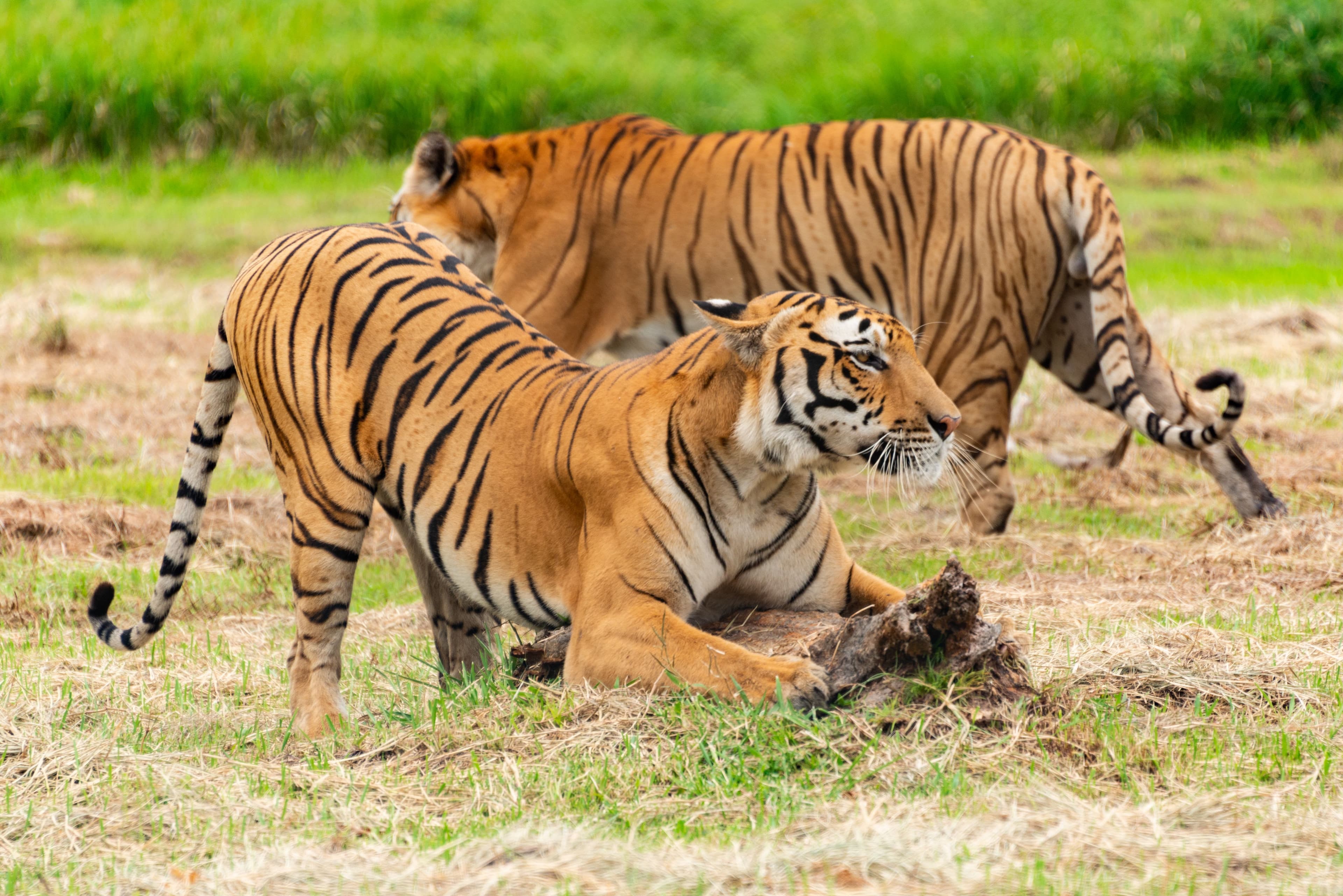
Not every tiger story ends at a lake at golden hour. Kankati — the name means "torn ear," from the nick that identifies her — is a daughter of Arrowhead (T-84) from her final litter, a great-great-granddaughter of Machhli (T-16), and the tigress at the centre of the most difficult months in Ranthambore's recent history. In 2025, still short of her second birthday, she was implicated in two fatal attacks on people, tranquilised, and moved out of the park. Telling her story straight matters, because it is really a story about how human care, given with the best intentions, can unmake a wild tiger.
A Litter Raised on Bait
Kankati was born in 2023, one of three cubs in Arrowhead's last litter — a brother later coded RBT-2508 and a sister RBT-2509. The litter's circumstances were unusual from the start: Arrowhead was already weakened by the tumour that would eventually kill her, and she struggled to hunt enough for three growing cubs. The forest department made a humane and fateful choice — supplementing the family with live bait near Jogi Mahal and the lake margins.
The cubs survived. But tigers that grow up fed within sight of people lose the deep wariness that keeps wild tigers and humans apart. By early 2025 the three sub-adults were ranging through the busiest corridor in the reserve — the pilgrim path to the Trinetra Ganesh temple inside Ranthambore Fort, walked by thousands of unarmed visitors every week.
The Attacks of 2025
On 16 April 2025, a seven-year-old boy was killed on the temple route near the fort. On 12 May 2025, a forest ranger, Devendra Chaudhary, was attacked and killed near Jogi Mahal. Kankati was identified as the suspect in both deaths. Days later she was tranquilised and moved into an enclosure at Naka Bhid while an expert committee weighed what to do — with a third fatality near the fort's Jain temple on 9 June deepening the crisis, and suspicion falling on her similarly bait-raised siblings.
The committee's recommendation was relocation of all three "raised" tigers, and through June 2025 it was carried out: the male RBT-2508 to Dholpur Tiger Reserve on 11 June, the female RBT-2509 to Ramgarh Vishdhari Tiger Reserve on 17 June, and Kankati herself to Mukundra Hills Tiger Reserve near Kota on 19 June. On the same day, Arrowhead — their mother — was found dead near Jogi Mahal, her long illness ending the family's era at the lakes in a single week.
Not a "Man-Eater" — A Management Failure
It is important to say what Kankati is not. She is not a habitual man-eater in the colonial-shikar sense; she is a young tigress who was taught, by circumstance, that humans and food arrive together. Wildlife managers distinguish sharply between predatory targeting of humans and the kind of proximity-bred accidents that follow habituation. That distinction is why she was translocated rather than destroyed, and why the episode has forced a public rethink of bait-feeding practices — a debate that will shape how the next ailing tigress with cubs is handled, in Ranthambore and beyond.
Her sisters Riddhi (T-124) and Siddhi (T-125) — raised wild by a healthy Arrowhead years earlier — carry the family line inside the park, both with new cubs in 2026. The contrast between the litters is the whole lesson, and you can see both branches side by side on our tiger family tree.
Frequently Asked Questions
Where is Kankati now?
At Mukundra Hills Tiger Reserve near Kota, Rajasthan, where she was shifted on 19 June 2025 after the expert committee's recommendation.
Why is she called Kankati?
From the torn (cut) ear that identifies her — "kan-kati" literally means one with a cut ear. Like most Ranthambore names, it began as a field identification mark.
Was Kankati born dangerous?
No. Her litter was part-raised on bait because her mother Arrowhead was dying of a tumour and could not hunt enough. Habituation to people — not innate aggression — is the accepted explanation for the 2025 attacks.
What happened to her brother and sister?
Both were also relocated in June 2025: the male RBT-2508 to Dholpur Tiger Reserve, and the female RBT-2509 to Ramgarh Vishdhari Tiger Reserve.
Similar Articles
Machli (T-16) — The Tiger Queen of Ranthambore
Discover the captivating story of Machhli (T-16), Ranthambore’s most famous tigress. Known as the "Crocodile Killer" and "Queen of the Jungle," her fierce spirit, legendary battles, and extraordinary legacy redefined the wilderness of India.
Is really Ustad (T-24) a Man-Eater?
Was Ustad (T-24) truly India's most feared man-eater, or was he a wild tiger caught in the growing conflict between greedy human and nature? Unearth the story behind one of Ranthambore's most controversial legends.
Aurangzeb (T-57) — The Male Behind Ranthambore's Zone 1 Cubs
Aurangzeb (T-57), also recorded as Singhasth, was a dominant Ranthambore male who fathered Noor's 2016 litter — including Sultana. He did not, despite the myth, father Riddhi and Siddhi.
Ganesh (T-120) 'Charger' — The King of Ranthambore's Lakes
Ganesh (T-120), the mock-charging male of Zones 3–4, is Riddhi's mate, father of Shubh and the 2026 cubs — and, through his mother Chanda, a great-great-grandson of Machhli himself.
Husn Ara (T-30) — Matriarch of the Gilai Sagar Line
Husn Ara (T-30), a prolific tigress of the Gilai Sagar dynasty, mothered a string of well-known Ranthambore tigers including Hamir (T-33), Fateh (T-42) and Surzan (T-43).