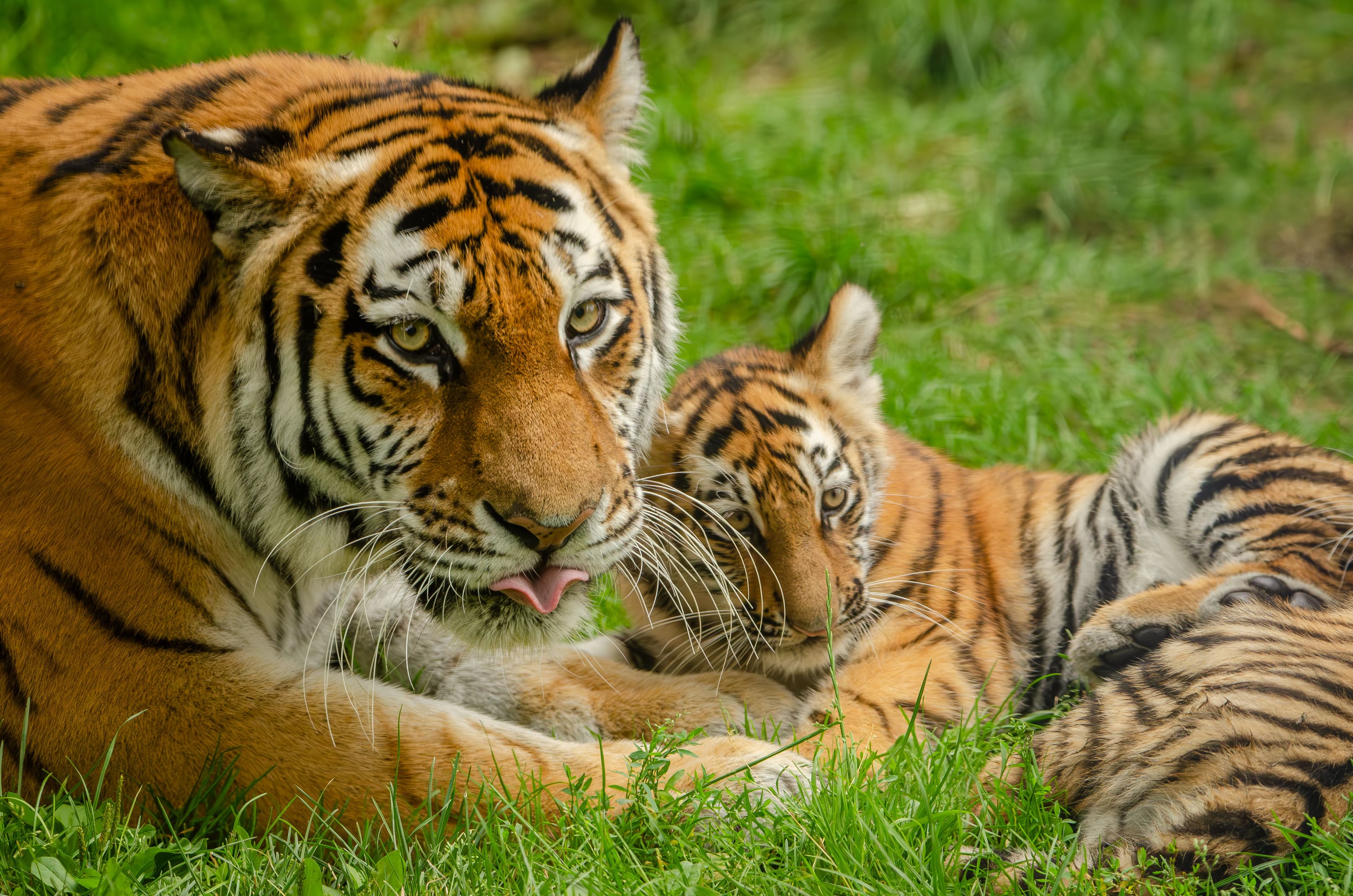
Her name means "the beloved one," and Ladli — coded T-8, sometimes written Ladali — earned it as the smallest and shyest cub in her litter, her mother's clear favourite. She grew out of that timidity into something formidable: the dominant tigress of Ranthambore's rugged southern zones, holding territory across Zones 6, 7 and 8 for years. Her story also carries one of the most persistent errors in the park's popular family trees, which we set straight below.
Daughter of the Kachida Valley
Ladli was a daughter of the Kachida Female (T-5), fathered by the male T-2, born in the harsh, beautiful country south of the fort. As a cub she was noticeably retiring — hanging back while her siblings pushed forward — which is exactly what won her T-5's extra attention and her enduring nickname. That early caution never fully left her; even as a territorial adult she was known as a tigress who preferred to melt into the dhok scrub rather than face down a vehicle.
Her mother's early death in 2011 set up the famous Dollar orphan-rearing saga involving Ladli's younger half-sisters — see Dollar (T-25) — but Ladli herself was already independent by then, a grown tigress establishing her own kingdom.
Ruler of Zones 6, 7 and 8
Ladli claimed the Balas, Chidi Khoh and Kundal country — the arc of dry valleys and plateaus that make up Zones 6 to 8 on the Khandar and southern side of the reserve. This is less-visited terrain than the lakes, and the tigers who hold it tend to be self-reliant hunters rather than lakeside showpieces. She raised at least one well-documented litter around 2011: a female, T-61, who settled in Zone 8, and a male, T-62, who dispersed out of the park entirely — the usual divergence of daughter-stays, son-leaves that structures every tiger family.
Setting the Record Straight
Here is the myth: many online family-tree charts list Ladli (T-8) as the mother of Packman (T-85), the male from the famous 2014 lake litter. She was not. Packman was a cub of Krishna (T-19), born by the lakes in February 2014 — a completely different tigress in a completely different part of the park. The mix-up probably stems from careless copying between tiger-list websites, and it is exactly the kind of error our verified tiger family tree exists to correct, because getting lineage wrong erodes the authority of everything else on a page.
Ladli's Place in the Park
Ladli represents the half of Ranthambore that rarely trends: the southern-zone tigers, holding dry, difficult ground away from the camera crowds. Her line through T-61 kept the Kachida valley bloodline present in the park even as her half-sisters' descendants flourished two hundred kilometres away in Sariska. For safari-goers willing to trade guaranteed lake drama for genuine wilderness, Zones 6–8 — Ladli's old kingdom — remain among the most rewarding and least crowded corners of the reserve, as our safari zones guide explains.
Frequently Asked Questions
What does the name Ladli mean?
"Beloved" or "darling" — she was the shy favourite of her mother, the Kachida Female (T-5), as a cub, and the name stayed with her.
Was Ladli the mother of Packman (T-85)?
No. This is a common error in online tiger charts. Packman was the son of Krishna (T-19), born in the lake zones in 2014. Ladli was a southern-zone tigress from a different line entirely.
Where was Ladli's territory?
Zones 6, 7 and 8 — the Balas, Chidi Khoh and Kundal areas on the southern and Khandar side of Ranthambore.
Who were Ladli's parents?
The Kachida Female (T-5) and the male T-2. She was from an earlier litter than the two orphaned cubs later raised by Dollar (T-25).
Similar Articles
Machli (T-16) — The Tiger Queen of Ranthambore
Discover the captivating story of Machhli (T-16), Ranthambore’s most famous tigress. Known as the "Crocodile Killer" and "Queen of the Jungle," her fierce spirit, legendary battles, and extraordinary legacy redefined the wilderness of India.
Is really Ustad (T-24) a Man-Eater?
Was Ustad (T-24) truly India's most feared man-eater, or was he a wild tiger caught in the growing conflict between greedy human and nature? Unearth the story behind one of Ranthambore's most controversial legends.
Aurangzeb (T-57) — The Male Behind Ranthambore's Zone 1 Cubs
Aurangzeb (T-57), also recorded as Singhasth, was a dominant Ranthambore male who fathered Noor's 2016 litter — including Sultana. He did not, despite the myth, father Riddhi and Siddhi.
Ganesh (T-120) 'Charger' — The King of Ranthambore's Lakes
Ganesh (T-120), the mock-charging male of Zones 3–4, is Riddhi's mate, father of Shubh and the 2026 cubs — and, through his mother Chanda, a great-great-grandson of Machhli himself.
Husn Ara (T-30) — Matriarch of the Gilai Sagar Line
Husn Ara (T-30), a prolific tigress of the Gilai Sagar dynasty, mothered a string of well-known Ranthambore tigers including Hamir (T-33), Fateh (T-42) and Surzan (T-43).