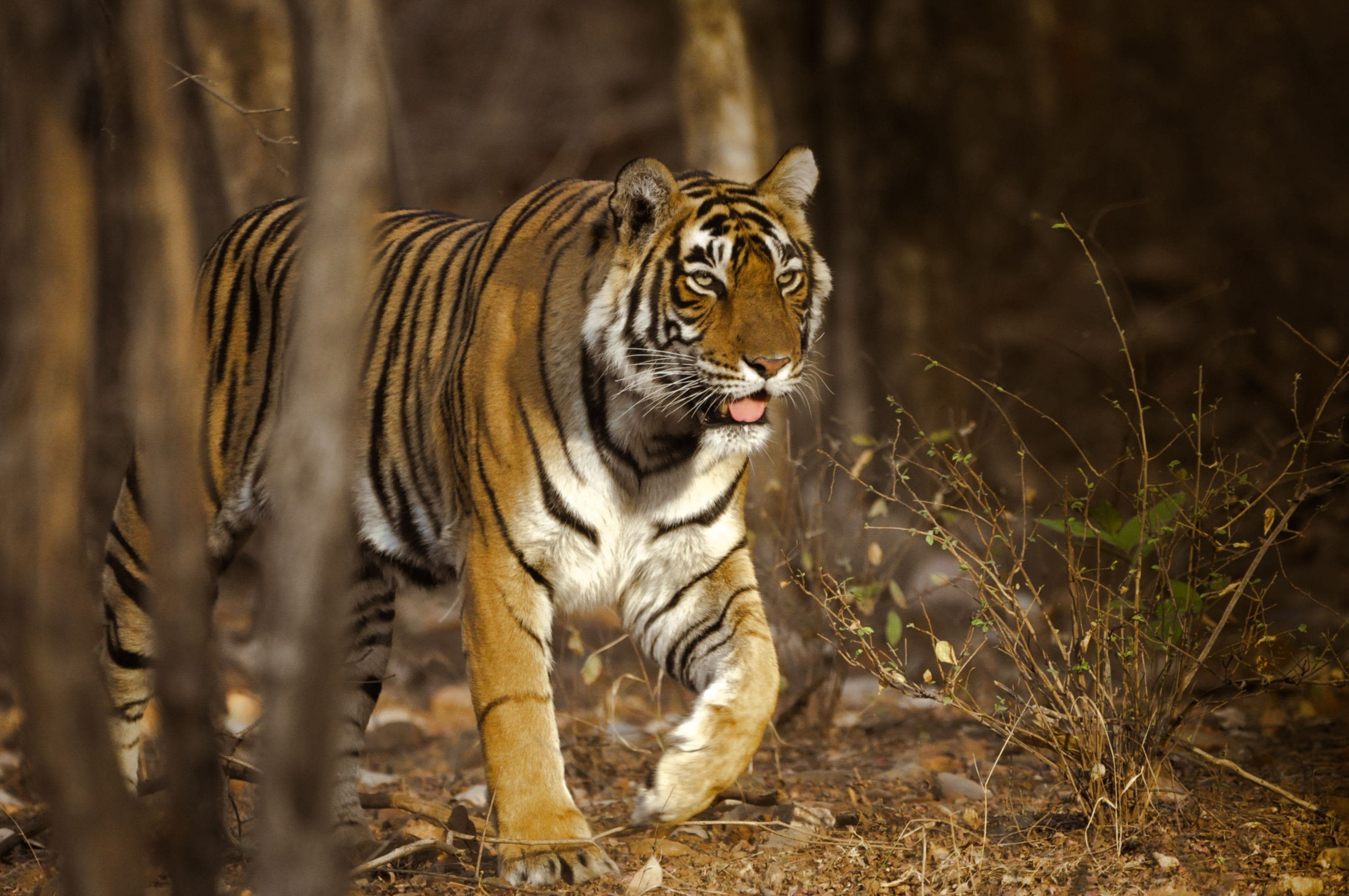
Every dynasty needs a patriarch, and for Ranthambore's lake bloodline that tiger was the Star Male, coded T-28 — a broad-headed, even-tempered male named for the star-shaped stripe pattern on his left cheek. He ruled the heart of the tourism area through the mid-2010s, and as the mate of Krishna (T-19) he fathered the most consequential litter in the park's modern history: Lightning (T-83), Arrowhead (T-84) and Packman (T-85), born in February 2014.
Territory: The Fort's Shadow
T-28, also called Sitara ("star" in Hindi), was born around 2006 and rose to dominance over a huge sweep of prime habitat — the lakes, the Nalghati and Lakarda valleys and the approaches to Ranthambore Fort, roughly today's Zones 2 to 5. Male tigers hold territory two to three times the size of a tigress's, overlapping several females, and T-28's range covered Krishna's lake domain almost exactly. For years the two were the park's ruling pair, and canny visitors who tracked Krishna's cubs often got the bonus of the big male trailing at a distance.
He was a famously tolerant father by wild-tiger standards. Guides recall T-28 sharing kills within sight of the 2014 litter — behaviour that echoes the park's other famous paternal male, Dollar (T-25), who went further still and raised two orphaned cubs alone.
The 2014 Litter That Changed the Park
Krishna's February 2014 litter — one male, three females, all sired by T-28 — grew up in front of thousands of safari visitors and turned the lakes into the most reliably dramatic tiger theatre in India. Through them, T-28's genes run through the entire modern lake dynasty: he is the grandfather of Riddhi (T-124) and Siddhi (T-125), and a great-grandfather of Shubh (T-2505) and of the cubs born in 2026. The full chain is easiest to see laid out on our tiger family tree.
Popular tiger lists also attribute further offspring to him across other zones — the male Dev (T-86) is the name most often mentioned — though the official record is thinner there, and we flag those links as unverified on the family tree.
A Sudden, Unusual Death
T-28 died on 20 March 2018 inside the reserve. The post-mortem finding was unusual for a wild tiger: gastric torsion — a twisting of the stomach — rather than the territorial wounds that end most male tigers' lives. He was around twelve years old. Several family-tree charts circulating online give his death year as 2023; the forest department's 2018 record is correct, and it explains why new males were already contesting the lake zones by 2019.
Why Star Male Matters
Male tigers rarely get the fame of the great tigresses — they don't den, so they aren't watched with cubs month after month. But a stable, long-reigning male is what makes a dynasty possible: by keeping rival males out for the better part of a decade, T-28 gave Krishna and then Arrowhead the security to raise litter after litter in the open, in front of visitors. The spectacle Ranthambore is famous for — tiger families at the lakes, described by Rajasthan Tourism as India's best daytime tiger viewing — was, in a real sense, his doing.
Frequently Asked Questions
Why was T-28 called the Star Male?
For a star-like arrangement of stripes on his left cheek — the identification mark guides used to tell him apart, which became his name. Hindi-speaking guides also called him Sitara.
Which famous tigers did Star Male father?
The February 2014 litter with Krishna (T-19): Lightning (T-83), Arrowhead (T-84) and Packman (T-85). Through Arrowhead he is grandfather to Riddhi, Siddhi and Kankati.
How did Star Male die?
Of gastric torsion — a twisted stomach — on 20 March 2018, confirmed by post-mortem. He was roughly twelve. Online charts giving 2023 are in error.
Where was his territory?
The fort-side and lake zones of the tourism area, roughly Zones 2–5 — see our safari zones guide for how those zones map today.
Similar Articles
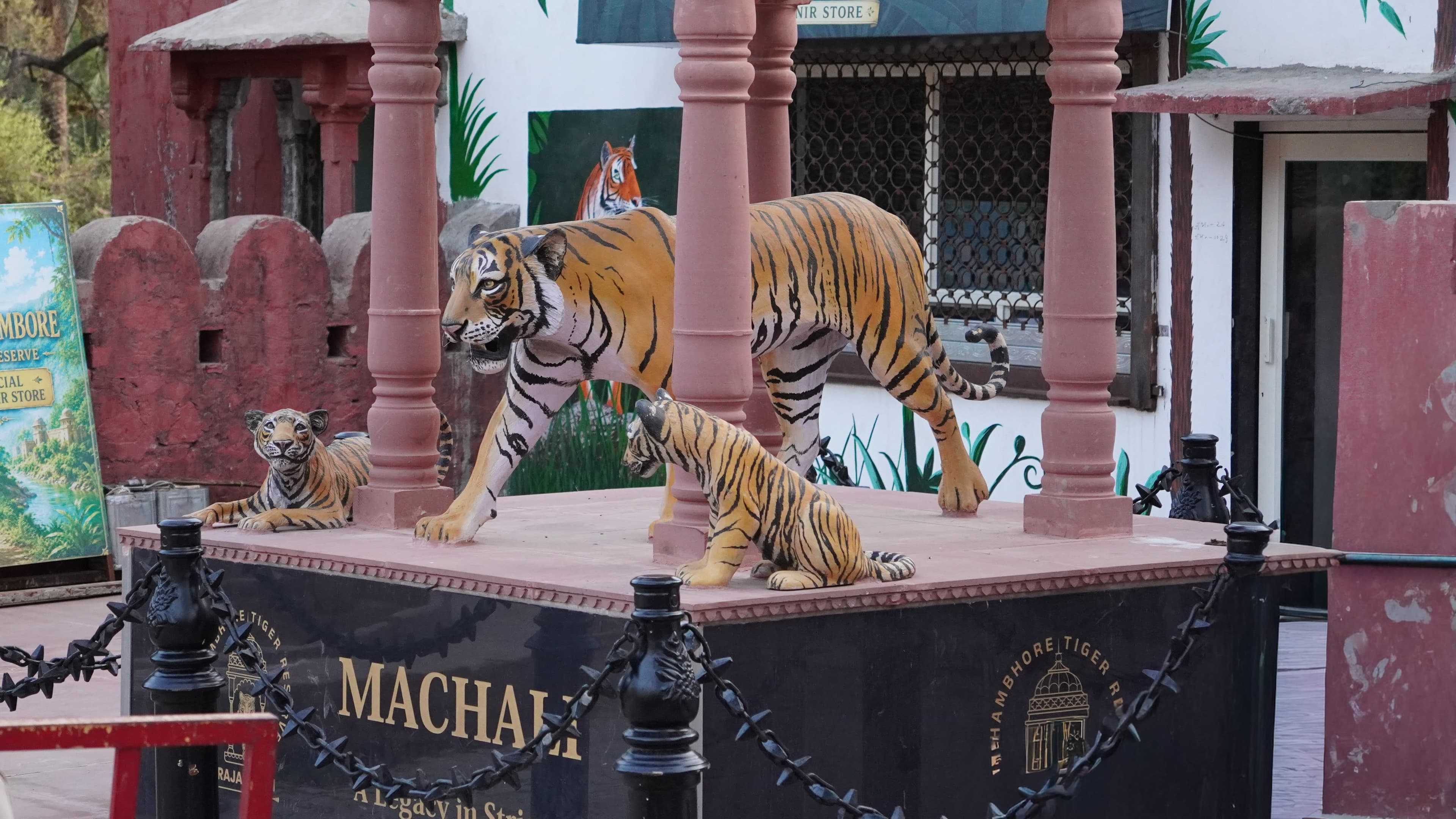
Machli (T-16) — The Tiger Queen of Ranthambore
Discover the captivating story of Machhli (T-16), Ranthambore’s most famous tigress. Known as the "Crocodile Killer" and "Queen of the Jungle," her fierce spirit, legendary battles, and extraordinary legacy redefined the wilderness of India.
Is really Ustad (T-24) a Man-Eater?
Was Ustad (T-24) truly India's most feared man-eater, or was he a wild tiger caught in the growing conflict between greedy human and nature? Unearth the story behind one of Ranthambore's most controversial legends.
Aurangzeb (T-57) — The Male Behind Ranthambore's Zone 1 Cubs
Aurangzeb (T-57), also recorded as Singhasth, was a dominant Ranthambore male who fathered Noor's 2016 litter — including Sultana. He did not, despite the myth, father Riddhi and Siddhi.
Ganesh (T-120) 'Charger' — The King of Ranthambore's Lakes
Ganesh (T-120), the mock-charging male of Zones 3–4, is Riddhi's mate, father of Shubh and the 2026 cubs — and, through his mother Chanda, a great-great-grandson of Machhli himself.
Husn Ara (T-30) — Matriarch of the Gilai Sagar Line
Husn Ara (T-30), a prolific tigress of the Gilai Sagar dynasty, mothered a string of well-known Ranthambore tigers including Hamir (T-33), Fateh (T-42) and Surzan (T-43).