Ranthambore Fort is one of India's most dramatic and historically layered citadels. Perched atop a steep granite hill approximately 700 feet above the surrounding plains, it dominates the heart of Ranthambore National Park and has borne witness to over a thousand years of Rajput valour, Sultanate sieges, Mughal conquest, and quiet decay. Designated a UNESCO World Heritage Site in 2013 as part of the Hill Forts of Rajasthan, it remains one of the most extraordinary fortresses on the subcontinent — not least because today its ancient courtyards are prowled by leopards, langurs, and the occasional Bengal tiger.
Origins — Who Built Ranthambore Fort?
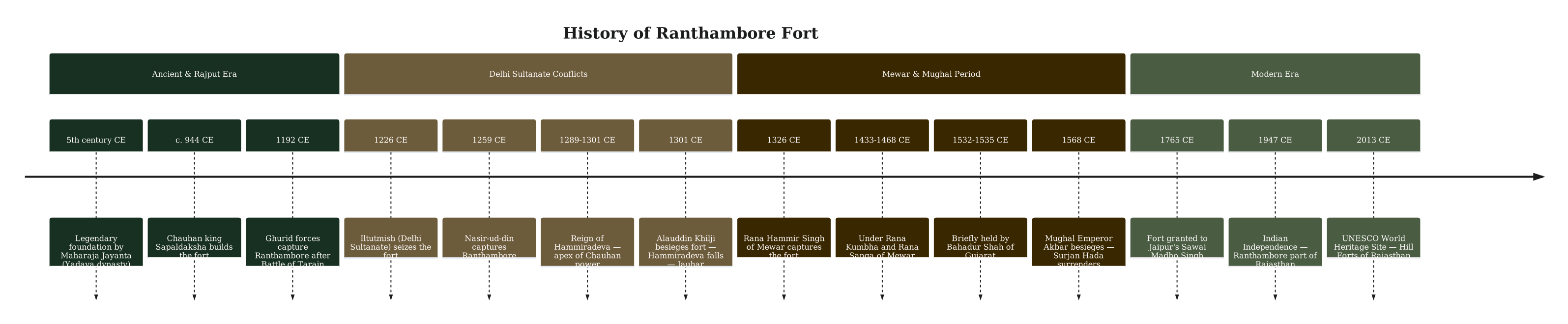
The fort's earliest origins are debated. The Archaeological Survey of India points to a foundation in the 5th century CE, attributing it to a Yadava king named Maharaja Jayanta. Rajput tradition, however, credits the Chauhan dynasty — specifically King Sapaldaksha around 944 CE — with establishing the fortress that would become the seat of the Chauhans of Ranastambhapura, as the city was originally known. Both accounts may be partially correct: an older fortification likely existed which the Chauhans dramatically expanded and reinforced.
The Chauhans of Ranthambore (1192–1301)
Following the Ghurid conquest of Ajmer in 1192, the defeated Chauhan clan under Govindaraja IV retreated to Ranthambore. The fort became the new capital of a diminished but fiercely independent Chauhan principality. Over the following century, the Chauhans of Ranthambore fought a grinding series of battles with the Delhi Sultanate — resisting Iltutmish in 1226, temporarily losing the fort, and then reasserting control under successive rulers.
Hammiradeva (r. c. 1283–1301) was the dynasty's apex. A Sanskrit epic, the Hammira Mahakavya (c. 1289), celebrates his martial achievements. He repelled Jalal-ud-din Khilji's raids and withstood Alauddin Khilji's first assault in 1299. But after a devastating three-month siege from January to March 1301, Ranthambore fell. Legend holds that the Chauhan women committed jauhar — self-immolation — rather than face capture. Hammiradeva died in battle. The fort passed to the Delhi Sultanate.
From Delhi Sultanate to Mewar and Mughal
After 1301 the fort changed hands repeatedly, as was common for strategic strongholds in medieval India. The Tughlaq sultans held it as a frontier outpost. In 1326 Rana Hammir Singh of Mewar captured it from Delhi, and Mewar control — interrupted by brief Sultanate recoveries — persisted until around 1468, when the Hada Rajputs of Bundi took over.
In 1532 the Gujarat Sultan Bahadur Shah briefly seized the fort, but Rao Surjan Singh Hada of Bundi recovered it. The decisive moment came in 1568 when the Mughal Emperor Akbar personally besieged Ranthambore. Surjan Singh, recognising the futility of resistance against the full Mughal war machine, negotiated a treaty in March 1568 — surrendering the fort in exchange for honourable terms. Ranthambore became a Mughal imperial outpost, later passing to the Jaipur Kachwaha ruler Sawai Madho Singh in 1765.
The Seven Gates
Ranthambore Fort's defences are built around seven successive fortified gates — called pols — that control the single winding approach road up the hillside. Each gate was designed to funnel attackers into a kill zone, forcing them to change direction and expose their flanks to defenders above.
Ganesh Pol — the outermost gate, where pilgrims and visitors first enter.
Andheri Pol — the "dark gate," a narrow passage deliberately kept unlit.
Navlakha Pol — the eastern entrance, 3.2 m wide with flanking guardrooms. A copper-plate inscription here records that Jaipur's Sawai Jagat Singh provided new wooden doors in the 18th century.
Hathi Pol — the elephant gate, wide enough for war elephants.
Sat Pol — the seventh gate in the inner sequence.
Suraj Pol — the sun gate, oriented to the east.
Delhi Gate — the innermost and most heavily defended gate.
Palaces, Temples, and Cenotaphs
Inside the fort walls, spread across multiple terraces on the hilltop, are the ruins of a self-contained royal city. The Hammir Mahal — built by Hammiradeva himself — was a multi-storeyed palace with stone ramp access and flat sandstone slab roofing. Nearby stands the Rani Mahal (Queen's Palace) and two courthouses, the Badi Kachahari and Chhoti Kachahari, used for royal administration.
Two magnificent memorial chhatris — open pillared pavilions with domed canopies — stand on the hilltop. The Batees Khamba Chhatri (32-pillared pavilion) and the Bara Khamba Chhatri (12-pillared pavilion) honour fallen Rajput rulers and warriors. Both date to the era of Hammiradeva and are among the finest examples of Rajput memorial architecture in Rajasthan.
The Trinetra Ganesha Temple
The fort's most celebrated structure is the Trinetra Ganesha Temple, dating to the 12th–13th century. It houses a unique image of Ganesha with three eyes — tri-netra — and is one of the most revered Ganesha shrines in Rajasthan. Pilgrims visit throughout the year, with the largest gatherings on Wednesdays and during the annual Bhadrapada Sudi Chaturthi fair, when tens of thousands of devotees make the steep climb to the fort. Smaller temples to Shiva (Mahadeo) and Vishnu (Ramlalji) stand nearby, along with Jain shrines dedicated to the 5th and 3rd Tirthankaras — a reflection of Rajput patronage of multiple faiths.
Water Systems
One of the fort's most ingenious and least celebrated features is its rainwater harvesting infrastructure. Numerous cisterns, stepwells, and open tanks are carved into the hilltop rock, feeding an underground system that collected and stored monsoon rainfall. This system gave the fort the capacity to withstand prolonged sieges — Hammiradeva's defenders held out for three months in 1301 in part because of these water reserves. Some of the tanks still function today.
UNESCO Heritage Status and ASI Conservation
In 2013 Ranthambore Fort was inscribed on the UNESCO World Heritage List as one of the six Hill Forts of Rajasthan, recognised under criteria for outstanding examples of Rajput military architecture adapted to dramatic natural terrain. The citation specifically notes that 'the dense forest here is used as a natural barrier' — the surrounding jungle of what is now the national park forming as much a part of the fort's defence as its stone walls.
The Archaeological Survey of India maintains the fort as a Monument of National Importance. Recent conservation work (2024–25) has included replacement of decayed lime plaster, repair of damaged stone elements, restoration of jali screens, chajja eaves, and ramps, and clearance of encroaching vegetation. These interventions aim to stabilise the ruins without disrupting the atmospheric quality of decay that makes the fort so visually compelling.
Timeline of Ranthambore Fort
Fort Structure — Architectural Overview

Visiting Today
Ranthambore Fort is open to visitors as part of Ranthambore National Park. Entry is included with a safari permit for Zones 1 and 3, which pass through the fort approach road. Visitors can explore the gates, palaces, temples, and chhatris on foot. The climb to the upper terraces rewards with panoramic views across the park's lakes and forests — and on a lucky day, a tiger moving through the ruins below. Entry tickets are ₹15 for adults and ₹10 for children.
Frequently Asked Questions
Can I visit Ranthambore Fort without a safari permit?
Entry to the fort is included with a safari permit for Zones 1 and 3, which pass through the fort approach road — you can't visit it as a separate ticketed monument outside a safari.
Why is Ranthambore Fort a UNESCO World Heritage Site?
It was inscribed in 2013 as one of the six Hill Forts of Rajasthan, recognised for its Rajput military architecture adapted to dramatic natural terrain — with the surrounding jungle itself forming part of its defences.
How old is Ranthambore Fort?
Its origins are debated between a 5th-century CE Yadava foundation and a 944 CE Chauhan foundation — either way, it has stood for over a millennium through Rajput, Sultanate, and Mughal rule.
Similar Articles
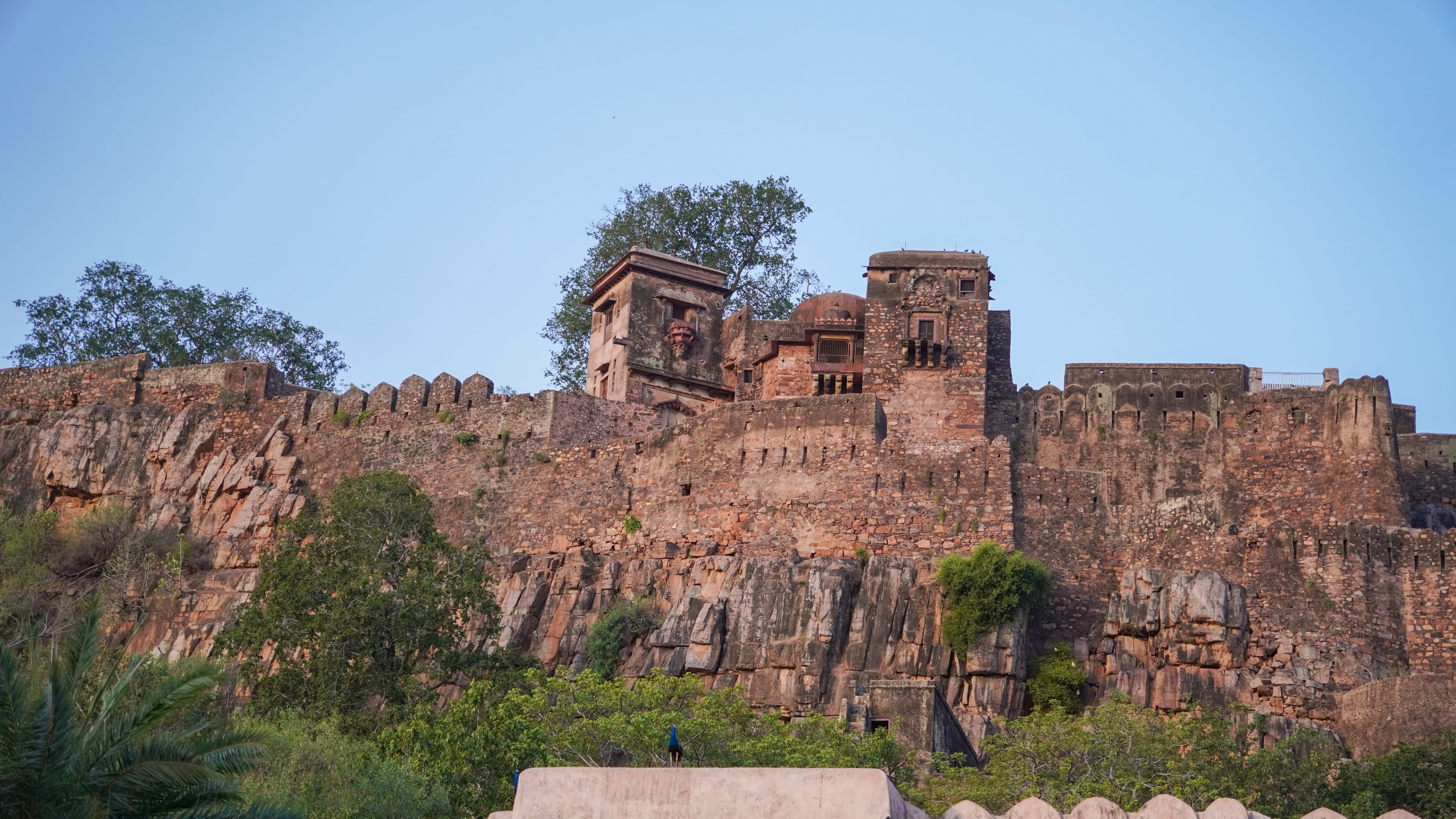
Ranthambore Fort Timings, Tickets & How to Visit
Ranthambore Fort is open sunrise to sunset (about 6 am–6 pm) and entry is free — no safari permit needed. The timings, the climb, how to reach it, and tips.

Trinetra Ganesh Temple Ranthambore: Timings & History
Trinetra Ganesh Temple timings: five aartis daily from 6 am to 8 pm inside Ranthambore Fort. Darshan hours, King Hammir's legend and the wedding-card ritual.