Mukundra Hills Tiger Reserve is a 759-square-kilometre wilderness in the hills southeast of Kota, and the third tiger reserve to be declared in Rajasthan after Ranthambore and Sariska. Long known locally as the Darrah Sanctuary, the reserve has spent the last decade rebuilding a tiger population that was reintroduced from Ranthambore, and in 2026 it opened a new jungle safari route to the public for the first time in its modern history. For travelers already visiting Ranthambore, Mukundra offers a quieter, less-visited extension of the same Hadoti tiger landscape.
A Royal Hunting Ground Turned Tiger Reserve
The core of Mukundra Hills was originally called the Darrah Wildlife Sanctuary, declared a protected area in 1955. Before independence, the forest served as the hunting ground of the Maharajas of Kota, prized for its tiger and deer population. In 2004, the state government merged Darrah with two neighbouring sanctuaries, Chambal Wildlife Sanctuary and Jawahar Sagar Wildlife Sanctuary, to form Mukundra Hills National Park. The National Tiger Conservation Authority approved its upgrade to a full tiger reserve on 9 April 2013, making it Rajasthan's third after Ranthambore and Sariska.
Geography and Landscape
Mukundra Hills forms part of the Vindhyan hill range, described by conservation authorities as two long, nearly parallel flat-topped ridges running between the Chambal and Kali Sindh rivers. The reserve spans four districts — Kota, Bundi, Chittorgarh and Jhalawar — with roughly 417 sq km of core critical tiger habitat and 342 sq km of buffer zone. The Chambal River forms much of its eastern boundary, feeding the wetlands, waterfalls and rocky gorges that give the landscape its character. The forest itself is dry deciduous, dominated by dhok trees along with sheesham, salar, khair, arjun and other mixed species.
Where Tourists Can Go Today
For most of the last decade, Mukundra's core tiger habitat was closed to tourism while the forest department focused on rebuilding the reintroduced tiger population. That began to change in January 2026, when the Chief Wildlife Warden granted permission to open the core area for regulated tourist safaris and the forest department began registering dedicated safari vehicles. In August 2026, the reserve went further, opening a purpose-built jungle safari route through the Borabas Range, entered through a new gate at Daulatganj rather than the older, more distant Darrah checkpoint.
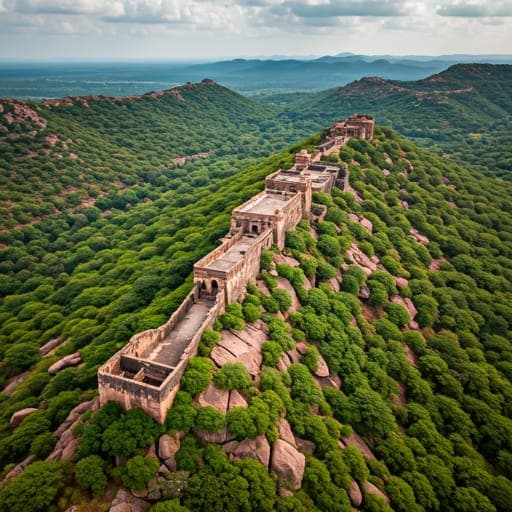
The new 16-kilometre route runs along the Chambal riverbank past the ruins of Kotya Bhil Fort and Akelgarh Fort, the Chambal View Point and Garadia View Point, with fresh watch towers and safety railings built along the river cliffs. It sits much closer to Kota city than the original Darrah gate, which is roughly 48 to 56 km away, making a Mukundra safari a realistic half-day trip for travelers based in Kota rather than a full expedition.
Zones of Mukundra Hills
The reserve is built from its three founding sanctuaries — Darrah, Chambal and Jawahar Sagar — with the new Borabas Range safari route as the current focus for tourism. Alongside the jungle safari, Mukundra also runs a boat safari on the Chambal River, with a shorter ride to Bhanwar Kunj and a longer one to Garadia Mahadev. That combination makes it one of the very few tiger reserves in India offering both a jungle safari and a river safari within the same protected area.
Frequently Asked Questions
Is Mukundra Hills Tiger Reserve open to tourists?
Yes. After years with limited public access, the core area was cleared for tourist safaris in January 2026, and a dedicated jungle safari route through the Borabas Range opened via the Daulatganj gate in August 2026.
How is Mukundra Hills different from Darrah National Park?
Darrah is the historic name for the original sanctuary at the heart of the reserve. It was merged with the Chambal and Jawahar Sagar sanctuaries in 2004 to form Mukundra Hills National Park, which became a tiger reserve in 2013 — so Darrah is best understood as the core of today's Mukundra Hills Tiger Reserve rather than a separate park.
Can Mukundra Hills be combined with a Ranthambore trip?
Yes, and many travelers do exactly that. Mukundra is roughly 130 km by road from Sawai Madhopur, and several of its tigers were themselves relocated from Ranthambore, so the two reserves share a direct lineage. See the full safari cost breakdown, how to reach Mukundra and a side-by-side comparison with Ranthambore for planning details.
Similar Articles
How to Reach Mukundra Hills Tiger Reserve from Kota, Ranthambore & Jaipur
Road, rail and air options for reaching Mukundra Hills Tiger Reserve near Kota, plus how to combine it with a Ranthambore tiger safari.
Mukundra Hills Safari Cost: Gypsy Prices, Inclusions & Booking
What a Mukundra Hills jungle safari costs — shared jeep seats, private gypsy hire, what's included, and how the newly opened Borabas Range route compares with Ranthambore.
Mukundra Hills vs Ranthambore: Which Rajasthan Tiger Reserve Should Travelers Choose?
Ranthambore and Mukundra Hills sit under three hours apart in the same Hadoti tiger landscape. Here is how the two reserves compare on tigers, crowds, cost and what each is actually best for.
Wildlife of Mukundra Hills Tiger Reserve: Tigers, Leopards, Sloth Bears & Birds
Inside Mukundra Hills Tiger Reserve's slowly recovering tiger population, its stronger leopard and sloth bear numbers, and the migratory birds that fill its wetlands each winter.